
What Are Support Cards?
Professional briefing cards for casualty simulation support. Triage identification, moulage instructions, and actor briefing on a single document.
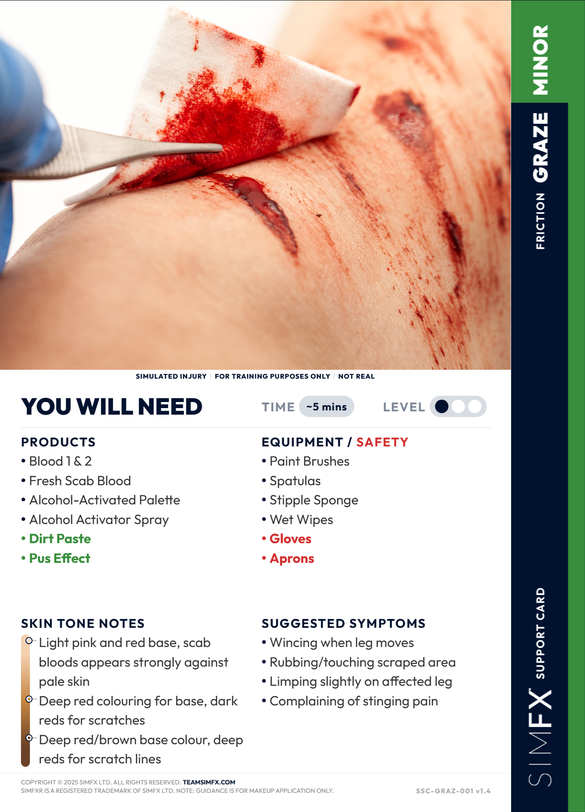
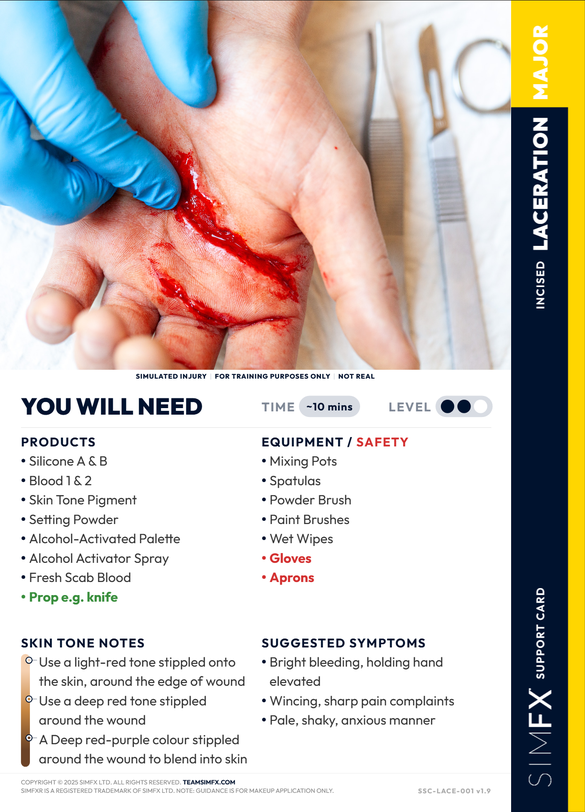
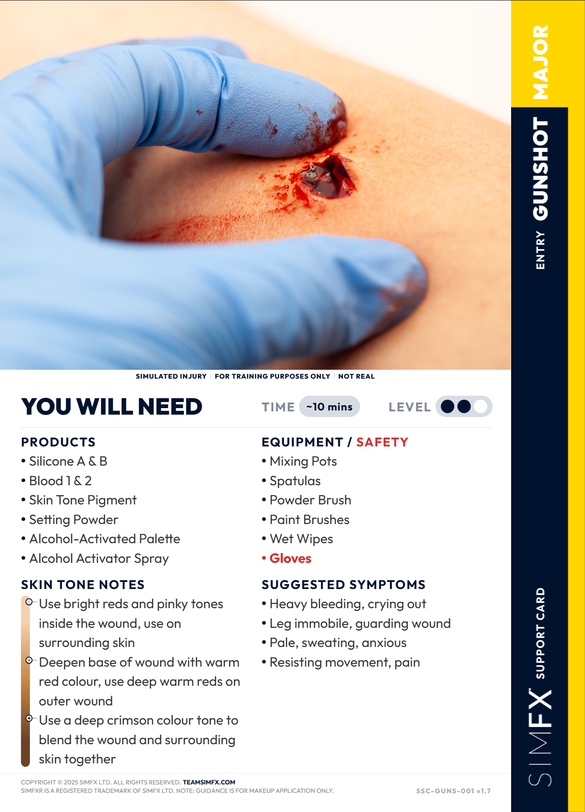
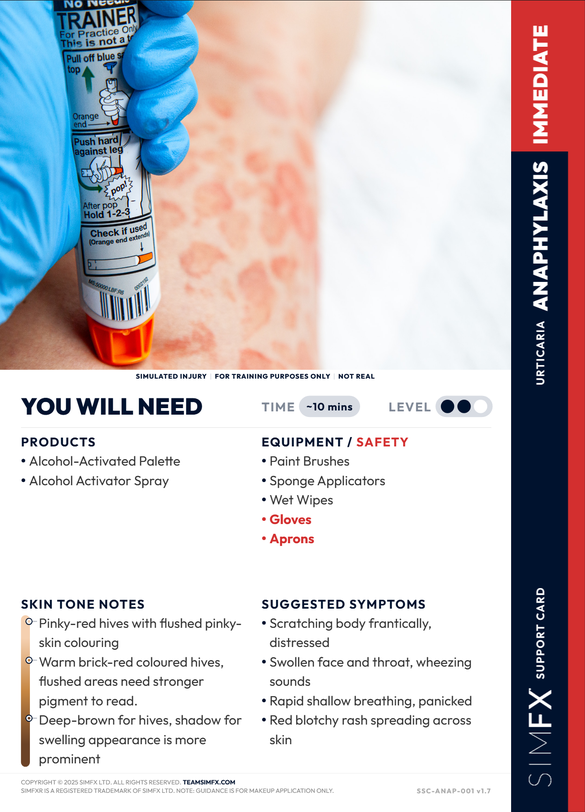
Briefing Cards for Simulation Support
In a casualty exercise, every second counts. SIMFX® Support Cards are lightweight, tear and water resistant artist reference cards. They can be used as a stand-alone reference or, worn on a colour-coded triage lanyard (available separately), they can be assigned to casualty actors.
Each card serves as a complete briefing document, at-a-glance triage identification, step-by-step moulage instructions for the makeup artist, and behaviour cues for the actor. Actors can carry multiple cards for complex casualty profiles.
No separate reference manuals. One wipe-clean card that carries the injury profile.
Cards are colour-coded by triage class, Immediate, Major, Minor, and Expectant, so exercise controllers and triage officers can identify casualty severity from across the field.
Available individually or as a configurable custom deck.
Have a suggestion or card request? Get in touch, we’re always expanding the library.
Three Audiences, One Document
Makeup Artists
Hero image, four-step visual application guide, complete materials list, PPE requirements, difficulty rating, and estimated application time. Everything a moulage artist needs to create the wound effect independently, no reference manual required.
Medical Responders
Where a casualty carries multiple injuries, responders must assess, prioritise, and communicate their findings under pressure, helping to develop effective decision-making and scene management skills.
Actors
Symptoms, pain behaviours, consciousness cues, and scenario context. Casualty actors receive everything they need to perform their role convincingly, without a separate briefing session or additional paperwork.
Triage Classes
Each Support Card is classified by triage severity. The colour coding carries through from the card design to the physical lanyard, so casualty identification works at every stage of the exercise.
Life-threatening conditions requiring urgent intervention. Casualties present with critical injuries, severe haemorrhage, respiratory distress, anaphylaxis, demanding immediate triage priority.
Serious injuries requiring prompt treatment. Gunshot wounds, deep lacerations, and significant trauma that need skilled intervention within the exercise timeline.
Non-life-threatening injuries. Grazes, bruising, superficial burns, and minor lacerations. These casualties can often self-present and move under their own power.
Casualties with injuries beyond the capacity of available resources. In a mass casualty scenario, these patients receive palliative care while resources are directed to survivable cases.

Get the complete method
Click to flip
Anatomy of a Support Card
Front Face
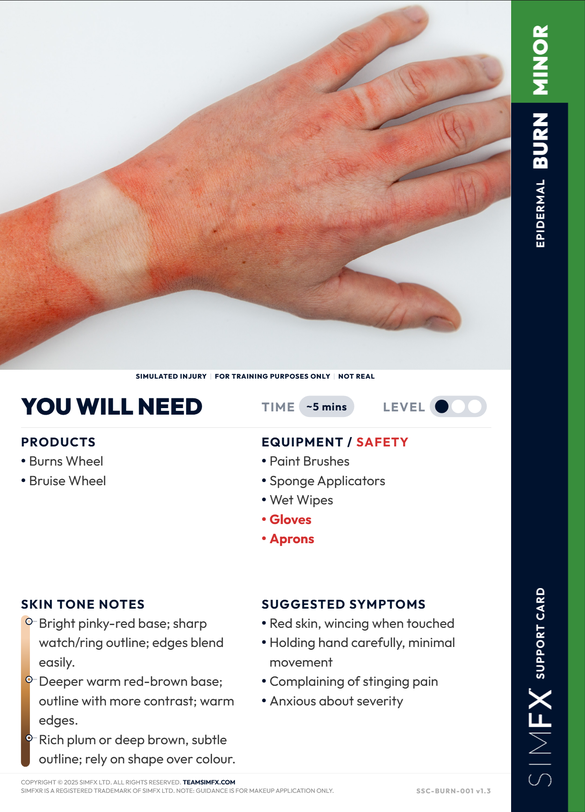
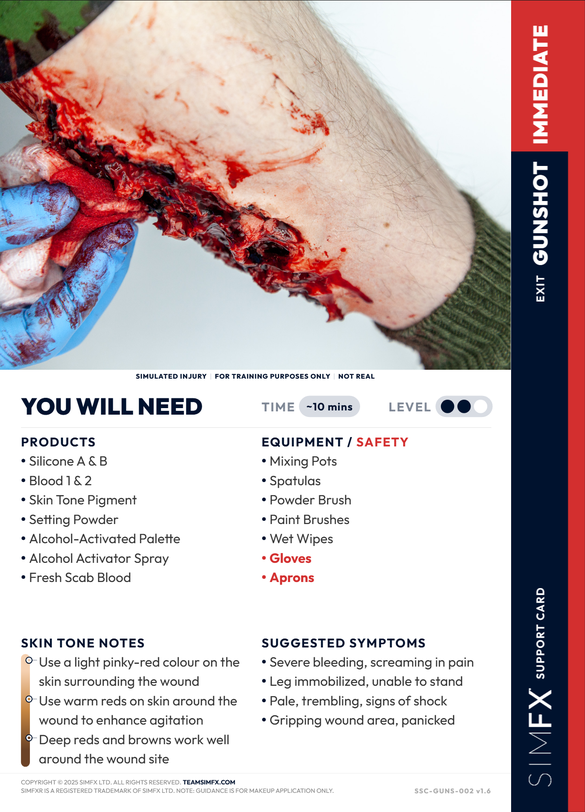
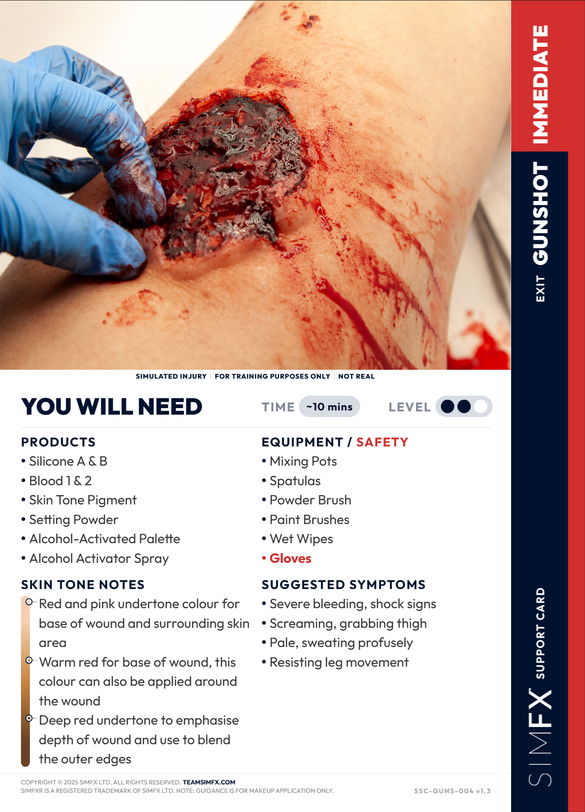
- Triage class, colour-coded severity band
- Injury type & subtype, wound classification and technique
- Hero image, finished wound reference photo
- Application method, silicone or makeup base
- Difficulty rating, skill level required (1–3)
- Time estimate, expected application duration
- Materials list, products, equipment, and PPE
- Symptoms, actor behaviour and presentation cues
- Skin tone notes, adaptation guidance
Back Face
- 4-step visual guide, photo-based application instructions
- Step-by-step text instructions, technique and explanation
- Trainer tips, additional realism notes
Preview Free, Learn the Full Method
Every Support Card in the online library shows the card front for free. The card back, the techniques that bring the wound to life, is not shown online. Learn the full method on a SIMFX® course, or purchase the printed cards via our shop.
Build Your Scenario
Planning a multi-casualty exercise? The SIMFX® Scenario Planner generates a complete exercise deck based on your casualty count, triage targets, time budget, and environment. It calculates total setup time, aggregates materials, and flags conflicts, so you arrive prepared.
Open Scenario Planner
CPD-certified methodology. Professional-grade materials. Designed by simulation practitioners with real-world field experience.